Last week I saw Broken Mirror Productions present a play called The Woman in the Window by Alma de Groen...
What I am about to write is not a theatre review. It will not talk about the strength of the actors (though the acting was superb – indeed, the reason I saw the show was on account of a friend’s performance... which was outstanding!), or the direction, or the elements of stage-craft employed in the production, etc. Rather it is simply an engagement with the content of the script qua text (perhaps a watered down redeployment of Luther’s “sola scriptura”).
The work is primarily a juxtaposition of late-Stalinist Russia with some imaginary digitalised future world in which an air of technocratic dystopia plus virtual-reality mind-control abounds. The plot itself is gripping and concerns the impact these totalitarian regimes have on the lives of two women. The first, Russian poet Anna Akhmatova (real historical person), is banned from writing by the state which has already taken her husband and son and spends her time in the company of friends reciting poetry and discussing literature (there is a particularly engaging critique of Chekov and Tolstoy). “Meanwhile,” the other, a space-age call girl, Rachel Sekerov, living no place more specific than an apartment (the final outcome of our ‘cosmopolitan Benetton soup’ – anywhere is everywhere and nowhere is unique), is coming to terms with the loss of her friend, the flatness of her existence, and the interactions she has been having through dreams and virtual simulations with various figures, none more astonishing than Anna herself. While the plot is interesting, I don’t intend to rehash it here; I only wish to consider some themes which struck me personally and, indeed, needn’t have come through particularly strongly to others. Surprisingly enough, even though the play focuses on the dictatorships of the past and future, it is unequivocally a tale of hope and, indeed, freedom.
Dimensions, Mushrooms, Shamans
The first idea that struck me begins with an aside the author throws to Siberian shamanism during Lilli’s interrogation. At one point the head interrogator pisses in a mug and gives it to her to drink. Lilli, who has hitherto been most unforthcoming, continues in this vein by pointing out, correctly and in some detail, that Siberian shamans used to drink piss to pass on the intoxicating effects (up to six cycles / through six people – fact!) of the “psychoactive mushroom” they had ingested (Amanita muscaria) [the modern actualisation of this Siberian shamanic archetype is, surprisingly enough, Santa Claus!]. This nod to shamanism also refers to her friend, Anna, who is herself a part-time “dreamer” in the prophetic, quantum, multi-dimensional sense of the term (as if there is one!). To this end, it is important to note that Lilli also, earlier in the piece, talks about “flatlanders” and the notion of multiple dimensions, especially those extending beyond our own. When these different tidbits are taken together (Derrida might call this focus on the crumbs working on/in the margins), they seem to make somewhat more sense than when initially delivered, at different times and places, with no preliminary sense of connection, by women trapped in the darkest moments of Soviet Russia.
These little moments - mentionings of quantum science, alternate dimensions, mysticism, shamanism, (and mushroom intoxication) – give the play a sense of reaching beyond its immediate surroundings; what is going on here is far deeper than simply the bullet, baton and boot of some authoritarian regime. To continue along this path leads us to the link between moon-worshipping cults and mushrooms as outlined by researchers such a Terrence McKenna in Food of the Gods.
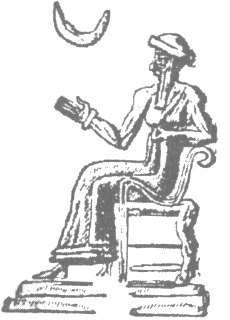 |
| The Babylonian Moon-god known as Harran or Sin wearing a rather distinctive headpiece resembling a mushroom cap. |
The various pieces of evidence that support this relationship between moon worship and mushrooms, such as the above picture or that mushrooms grow during the night, needn’t be inspected in great detail here. The mere proposition that there is a connection is sufficient for my moving further.
Lunar Reality – Virtual Moon
The Moon is a central symbol in de Groen’s work. It is emphasised throughout the play and Sandor Voss, one of the few sanctioned poets in the futuristic dystopia, recites his poem which focuses on it. That the celestial sphere, and the Moon especially, feature heavily in the “future” portion of the play has a few different representational significances. The focus on the Moon coincides with an abundance of virtual reality use and technological control in the futuristic society. The Moon makes its appearance as a symbol right at the moment that the characters in the play inhabit their virtual reality pods. This brings to mind the holographic nature of reality and the role the Moon plays in forming this world.
To begin this exploration we must entertain the notion of the Moon as an artificial satellite. On a (pseudo-?)scientific level this possibility is discussed in various texts such as Soviet scientists Michael Vasin’s and Alexander Shcherbakov’s article entitled Is the Moon the Creation of Alien Intelligence?, Who Built the Moon? by Christopher Knight and Alan Butler, and Our Mysterious Spaceship Moon by Don Wilson. An observation that carries weight for me is that the distance of the Moon from the Earth is exactly enough to allow total solar eclipses to occur (not too far from Earth) which then perfectly cover the Sun allowing us to see the corona (not too close). The probability of this occurring naturally is infinitesimal and seems to be too much of a coincidence for me to believe (though it could be). Another interesting observation to note is the frequencies the Moon gives off when struck by an asteroid or undergoing seismic vibrations which suggest that it has hollow properties (not necessarily completely hollow / hollow throughout but “very” hollow nonetheless). In Intelligent Life in the Universe Carl Sagan (with I. S. Shklovski) states that ‘[a] natural satellite cannot be a hollow object’ and this makes sense to me, as the collection of rocks/fragments/space dust etc. would be attracted to a point of gravity which would necessarily have to be the densest part of the whole. Subsequent additions would ensure that the densest part became/remained the centre of the object, as the centre of gravity. The hollowness of the Moon resonates with various mythologies such as Zulu legend, as retold by Credo Mutwa, which considers the Moon as an egg which has had its yoke sucked out. Indeed, the Moon’s existence produces so many unexplained anomalies that astrophysicist Irwin Shapiro has joked that the best explanation is observational error – the Moon does not exist.
The artificiality of the Moon is relevant to The Woman in the Window’s portrayal of the future as a place when information is heavily controlled and virtual reality is a kind of norm. Some researches, chief among them David Icke, suggest that the Moon is a kind of transmitter that influences the information received by us on the Earth. Insofar as our experience is mediated by this interference, the Moon is a virtual reality simulator. By transmitting certain frequencies, it can cancel out others and help determine the world’s potentialities / collapse the wave function. Television is a good analogy; if I’m watching one channel, I cannot watch another. We can take this analogy further: if I watch the news on Channel 7, I am tuning (through certain tools/antennae – in this case, my television) into a certain virtual reality based on the information that I receive (or is broadcasted to me) and the information that I don’t. Based on the stories reported and how they are conveyed, it may give me a distinctly different version of “reality” than if I were to watch the news on ABC, for example (however, if both were sufficiently similar, it mightn’t). This may again give me a different perspective on reality than if I witnessed the events myself or was party to them. Icke suggests that this interference is done by extraterrestrials [a modern resonance of this is the Death Star in Star Wars which is specifically likened to a moon] who seek to use the Earth for its resources by controlling us. I want to throw in Carlos Castaneda’s Don Juan at this point, who speaks of a similar “Predator race” in The Active Side of Infinity and other places, who control our mind and make it like theirs. In all these cases these entities are parasitic off us, or the Moon off the Earth, etc. This harks back to my very first blog post, and this is perhaps the most important thing I gleaned from the play.
Traditional Maintenance
The control and manipulation of digital information by the technocrats is a central aspect of de Groen’s work, which exemplifies the human involvement in the maintenance of the virtual reality. Certain files can only be accessed by certain people, while the vast majority of information simply falls deeper and deeper into the archives (as it fades further and further out of humanity’s memory/interest). The information to be kept is determined by utility and its perceived worth (shades of Melbourne Model, perhaps). One of the most striking lines of the play is where the metamorphoses of The Iliad are traced from originally being handed down orally through to being written, printed, then digitised, and finally completely lost. This echoes Plato’s discussion of writing as a “pharmakon” in The Phaedrus, where it is considered as both a remedy for forgetfulness, being a beneficial way of remembering, and a poison which weakens a person’s memory itself. A mode of tradition transmission is as essential as the content of the tradition. The way a story is remembered and passed down is as much a part of the story as the “plot,” as it were.
Now the element of hope which this piece offered becomes properly manifest. Anna teaches her forbidden poetry to close friends, thus circumventing the regime. This community of women forges their own discourse, their own tales, their own mythology – yes, it is only in small steps and, indeed, it seems as if the totalitarian drive triumphs – however, these small exchanges between women prove to be the very source of “salvation” for the future world through the communication of these stories in dreams (a telling resonance of the Indigenous “Dreamtime” and other traditions where intergenerational communication within one “tribe” is effected in the locale of the dream). In this way we can see how it is exactly the arrogance (hubris) of those on top who think that the world in its entirety can be controlled, formed, and/or understood or known which causes their very downfall, because there is always another realm uncontrolled, another land unexplored, where those who cannot grasp a thing in this world are “masters” because they are unattached to this reality. Here is perhaps one of the relevance’s of Christ’s Beatitudes, on a multidimensional level.
This kind of resistance is parasitic, and at this point I must gesture to my opening post where I discussed parasitism in depth. The very same parasitism (extraterrestrial/domination/etc.) which we are the victims of, that very same process is the way in which tradition can propagate when faced with domination, attaching to this source in places and using it as nourishment, but always seeing beyond it and not getting caught up with the host as a goal in itself. Yet these very same parasitic movements of tradition are those used by tomorrow’s ruling doctrines – the very relationship of the concepts parasite/host is symbiotic. Here, then, the distinction between parasitism and symbiosis becomes a blurred one indeed.
Poetry, art and other disciplines which might seem a cute distraction forged by the necessity of recreational activity at best or a waste of energy spewed out accidentally in an overenthusiastic response to evolutionary forces at worst can now be re-examined also. These are, in fact, the very domains which truly matter – just like the method of communication is part of the content itself (“the medium is the message;” McLuhan is a strong figure here) – these are the things that have the most utility. A final image which was clearly central to the text was that of the “tardigrade” (if I remember correctly) which can remain in a sleep-like state of stasis for many years – enduring extraordinary dryness, cold, and heat. In this way too the tales, the traditions, the poetry told by an oppressed Russian woman to one or two of her friends in an what appear to be a two-person underground academy, can survive the most arduous of conditions. My final pseudo-scientific construal is the notion of planetary seeding, that life moves across the vast expanse of space and in this way propagates its existence (in an inter-planetary sense) – the tardigrade is of immense interest to astronomers in this area for its endurance in even the harshest of conditions; it makes a good candidate. This links us again to Terence McKenna and the mushroom, whose spores he believed were another good candidate for the organism which could survive floating through the abyss of space before finding (or being found) by a suitable location.
All-in all, this text resonated with me on a very deep level. The above rant give spicks and specks of the plot and really only takes the many thematic layers in one direction. I strongly urge the author of this text to publish it (giving in to the pharmakon wholeheartedly). I don’t know if it would have made such an indelible impression on me if I had read it on the page rather than seen it performed, but either way, the layering of the themes should translate to ink rather well. In any case, check out local theatre! Small budgets but big ideas - what it tells you about yourself and the world around you can be, at times, astonishing...

Update:
ReplyDeleteApparently the tardigrade's hardiness (and small size) also make it a good candidate for being put through various quantum experiments (which challenge our notion of reality). Having a living thing in these "superposed" states - being a wave function in many different places simultaneously - would really push the limits of how we understand our world's existence and reality... Check it out:
http://www.newscientist.com/article/dn17792-could-we-create-quantum-creatures-in-the-lab.html